The Fingers in the Glove; the Proper Relationship between the Individual and Society
The Fingers in the Glove; the Proper Relationship between the Individual and Society is a book written by Granger, the leader of the wandering book people who live along the abandoned railroad tracks outside the city. Its title serves as a metaphor for the group's central belief: the individual is like a finger, and society is the glove that gives the finger its purpose and context. The book is never read aloud in the novel, but its title is spoken by Granger when he introduces himself to Montag, and its philosophy is enacted by the group's entire way of life. The work stands as a direct counterpoint to the firemen's ideology of enforced happiness, which demands that everyone be made equal by being reduced to the same featureless, interchangeable unit, and it offers a vision of human connection that Montag has been groping toward since his first encounter with Clarisse McClellan.
Identity and Origin
Granger identifies himself as the author of The Fingers in the Glove; the Proper Relationship between the Individual and Society when he first meets Montag by the campfire. He introduces himself by saying, "Myself: I wrote a book called The Fingers in the Glove; the Proper Relationship between the Individual and Society, and here I am!" The book is not a physical object that survives; like the other texts the wanderers carry, it exists only in Granger's memory. He has been a fugitive for years, ever since he struck a fireman who came to burn his library. The book's title is the only fragment of his work that remains, but it is enough to communicate its essential idea. The title itself is a compressed argument: the finger (the individual) is not a complete, independent entity; it is a part that only functions properly when it is fitted into the glove (society). The relationship is not one of subordination but of mutual completion—the glove gives the finger its shape and purpose, and the finger gives the glove its ability to grasp and act.
Philosophy and Meaning
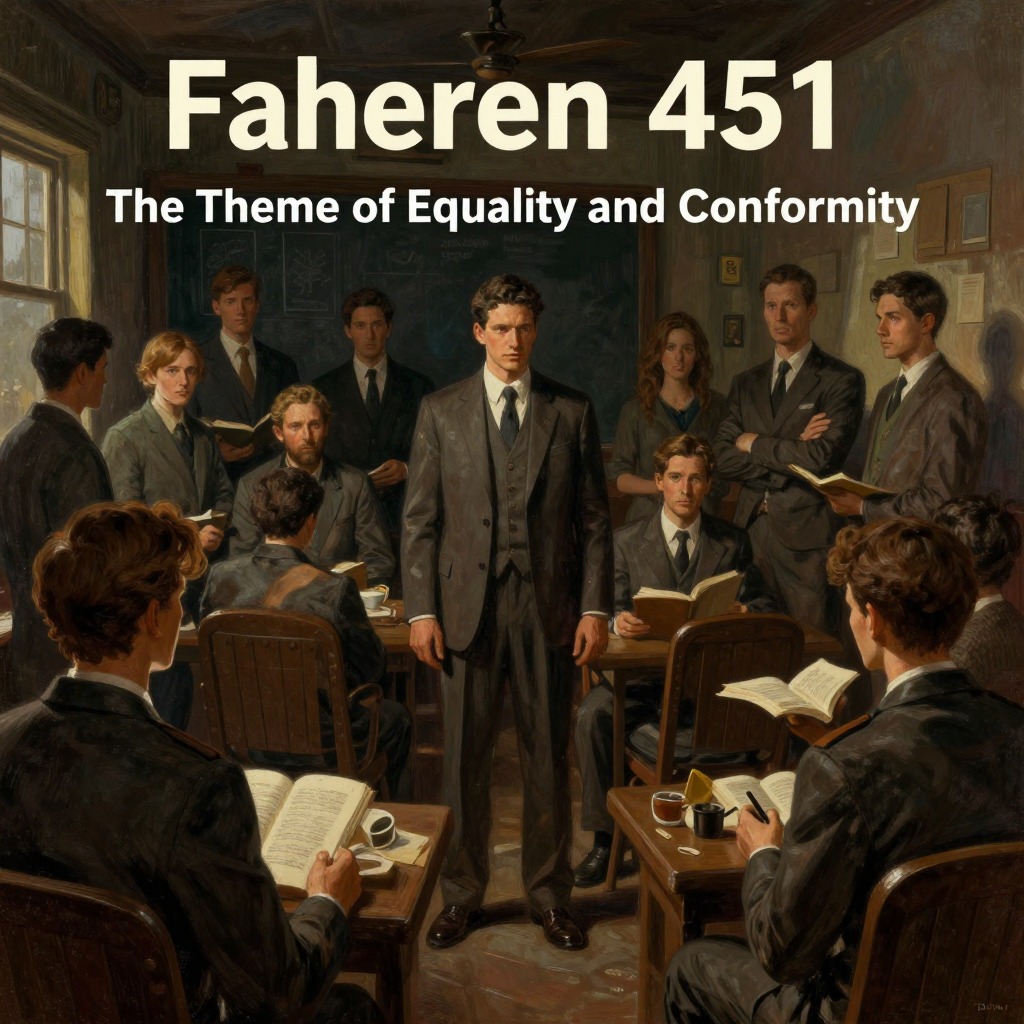
The philosophy of The Fingers in the Glove is the opposite of the firemen's doctrine of equality through sameness. Captain Beatty explains that the firemen's world is built on the principle that "we must all be alike. Not everyone born free and equal, as the Constitution says, but everyone made equal. Each man the image of every other; then all are happy, for there are no mountains to make them cower, to judge themselves against." In this system, individuality is a threat because it creates comparison, envy, and unhappiness. The firemen's solution is to burn the books that contain different ideas and to enforce a culture of mindless entertainment that keeps everyone distracted and identical. Granger's book proposes a different kind of unity: not the erasure of difference, but the coordination of distinct parts into a functioning whole. Each finger is different—different length, different strength, different role—but all are necessary for the hand to work. The glove does not crush the fingers into a single shape; it holds them together so they can act together.
Connection to Montag's Journey
Montag's entire arc in the novel is a movement from being a disconnected, isolated finger to finding his place in the glove. At the beginning, he is a fireman who burns books, but he feels a growing emptiness. He tells Mildred, "I'm so damned unhappy, I'm so mad, and I don't know why I feel like I'm putting on weight. I feel fat. I feel like I've been saving up a lot of things, and don't know what." He is a finger without a glove—a part that has no whole to belong to. His marriage to Mildred is a relationship without connection; they cannot remember where they met, and she is more absorbed in her "family" on the parlour walls than in him. His encounter with Clarisse McClellan is the first time he feels seen as an individual: "She was the first person I can remember who looked straight at me as if I counted." But Clarisse is killed, and Montag is left alone again. His theft of a book, his reading of poetry to the women, his murder of Captain Beatty, and his flight from the city are all desperate attempts to find a purpose and a connection that his society has denied him. When he finally meets Granger and the other wanderers, he finds the glove that his finger has been searching for.
The Wanderers as the Living Book
The wanderers do not merely carry books in their heads; they embody the philosophy of The Fingers in the Glove. Each man is a single book, a single finger, but together they form a complete library, a functioning hand. Granger explains: "We are all bits and pieces of history and literature and international law, Byron, Tom Paine, Machiavelli, or Christ, it's here." Fred Clement is Thomas Hardy, Dr. Simmons is Marcus Aurelius, another man is Plato's Republic, another is Jonathan Swift. They are not individuals who happen to know things; they have become the things they know. Granger tells Montag, "If anything should happen to Harris, you are the Book of Ecclesiastes. See how important you've become in the last minute!" The individual is not important in himself—"You're not important. You're not anything," Granger says—but he is indispensable as a part of the whole. The finger is nothing without the glove, but the glove is nothing without the fingers. This is the proper relationship: mutual dependence, not domination or erasure.
Thematic Significance
The title The Fingers in the Glove is the novel's answer to the problem of how to build a society that respects both individuality and community. The firemen's world has destroyed community by destroying the books that contain shared knowledge and by replacing genuine human interaction with the simulated intimacy of the parlour walls. Mildred's "family" is a parody of community: it talks to her, but it does not need her; it gives her the illusion of connection without the reality. The wanderers, by contrast, have built a real community out of shared memory and purpose. They are not a collection of isolated individuals; they are a network of people who have chosen to carry the burden of the past together. Granger's grandfather, a sculptor, taught him that "everyone must leave something behind when he dies," and that the difference between a lawn-cutter and a real gardener is "in the touching." The wanderers are gardeners of the human spirit, planting the seeds of knowledge in their own minds so that they can be replanted in the world after the war. Montag, who has spent his life destroying, finally becomes a creator, a finger in the glove of a new society.